(UK Home students only)
Residual body soils – sebum, sweat, skin fragments, product residues, environmental particles and microorganisms – persist on clothing after washing, forming complex microenvironments that drive malodour, yellowing, particulate adhesion and microbial survival. As laundering moves towards shorter cycles, lower temperatures, reduced water use and bio-based ingredients, understanding how these soils interact with fibre surfaces is increasingly important. Current studies usually examine single soil classes or organisms on simplified swatches, so it remains unclear where soils persist within real fabrics, how they protect or nourish microbes, and which molecular changes link retained lipids and proteins to odour and discolouration.
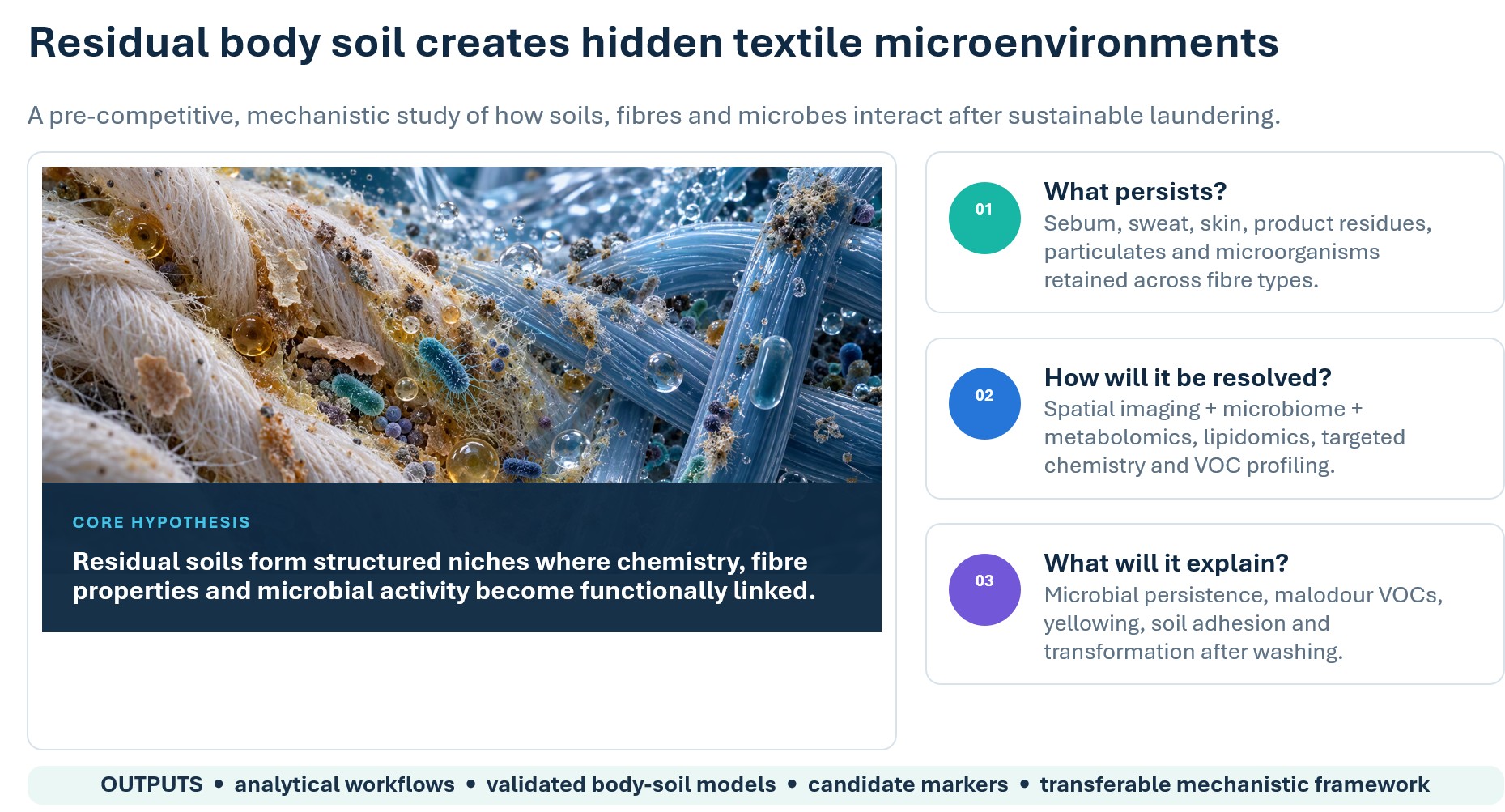
This project will test the hypothesis that residual body soils form structured microenvironments on fabrics, within which lipid oxidation products, proteins, metabolites, microbial communities and volatile organic compounds (VOCs) are functionally linked. The student will generate mechanistic insight into how human-derived soils persist on, and interact with, synthetic, cellulosic and blended fibres after laundering regimes representative of modern household practice.
The student will combine ethically sourced worn textiles, which provide biological realism, with defined in vitro models that allow hypothesis-led testing of fibre type, soil composition and wash conditions. Techniques will include in situ imaging to map soils and microbes on fibres, microbiome profiling (including MinION sequencing), MS-based metabolomics and lipidomics, targeted chemical analysis and VOC profiling, with all datasets linked by common sample identifiers for multivariate analysis. Year 1 covers approvals, training and pilot workflows; Year 2 generates before- and after-laundering datasets from worn textiles; Year 3 develops and tests the in vitro models; and Year 4 focuses on independent validation and synthesis.
The student will be based in Professor Jo Fothergill’s group at the University of Liverpool, co-supervised by Dr Howbeer Muhamad Ali (Centre for Metabolomics Research), with access to the Materials Innovation Factory. Placements of 8–12 weeks at Unilever R&D in Years 2 and 3, plus follow-up engagement in Year 4, will provide training in industrial experimental design, high-throughput approaches, data governance, intellectual property and project management. The student will also join the Unilever iDLA cohort programme, including data science training, cohort meetings and an annual workshop.
Outputs will include validated residual-soil models, analytical workflows, candidate soil markers and general principles explaining why some soils remain hidden within fibres, support microbial persistence or generate odour, as well as peer-reviewed articles and conference presentations. The findings will be relevant to surface microbiology, microbial ecology, surface science and sustainable laundering, and should transfer to other biologically conditioned surfaces.
Representative Publications / References
- Van Herreweghen et al., 2020, Microorganisms 8, 1709, doi:10.3390/microorganisms8111709. Biological and Chemical Processes that Lead to Textile Malodour Development
- Díez López et al., 2025, BMC Biology 23, doi:10.1186/s12915-025-02147-5. Unravelling the hidden side of laundry: malodour, microbiome and pathogenome | BMC Biology | Springer Nature Link
- Jacksch et al., 2021, Microorganisms 9, 1591, doi:10.3390/microorganisms9081591. Metatranscriptomic Analysis of Bacterial Communities on Laundered Textiles: A Pilot Case Study
- Liu et al. (2024). Volatile metabolomics and metagenomics reveal the effects of lactic acid bacteria on alfalfa silage quality, microbial communities, and volatile organic compounds
- Aguiar-Pulido V, Huang W, Suarez-Ulloa V, Cickovski T, Mathee K, Narasimhan G. Evolutionary Bioinformatics. 2016;12(Suppl 1):5–16. doi: 10.4137/EBO.S36436. Metagenomics, metatranscriptomics, and metabolomics approaches for microbiome analysis