(UK Home students only)
Would you like to help design personal care products that millions of people use every day?
Deodorants are part of daily life, but the science behind them is still evolving. Most products work by reducing bacteria on the skin broadly, and regulators and consumers are increasingly asking for smarter, gentler approaches. This PhD puts you at the centre of that challenge, working with the University of Liverpool and Unilever.
The big idea
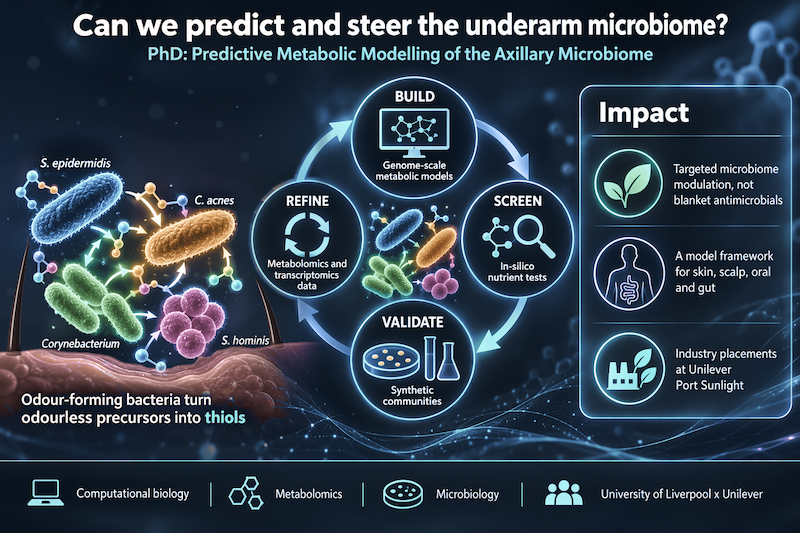
Underarm odour isn't caused by sweat itself. It happens when bacteria living on our skin turn odourless substances into smelly molecules. These bacteria form a community, the skin microbiome, and people with stronger odour tend to carry more of the odour-producing species. The underarm is dominated by just a handful of species, which makes it an ideal place to ask a bold question: can we understand how this community works well enough to nudge it towards a low-odour balance, rather than simply wiping it out?
How you'll do it
You'll move between computer and laboratory in a four-step cycle:
- Build: create computer models of the chemistry inside each bacterium, known as genome-scale metabolic models, and link them to simulate a whole community. Models for key species such as Staphylococcus hominis and Corynebacterium tuberculostearicum don't yet exist, so you'll build them.
- Screen: use the simulations to predict which nutrients would shift the balance away from odour-producing bacteria, and which species compete or feed one another.
- Validate: test the best predictions in the lab by growing small, defined communities of two to three bacteria together. You'll measure their growth with techniques such as qPCR and shotgun metagenomics.
- Refine: use mass spectrometry-based metabolomics, isotope-labelled substrates and meta-transcriptomics to see what the bacteria actually do. Then feed the results back to make the models more accurate with every round.
Training in microbiology, metabolomics and data science, including Python and R, is provided, so you don't need to arrive as an expert in every area.
This work is pre-competitive, so its aim is to build general principles, models and methods that others can use. If it succeeds, it could support more targeted alternatives to blanket antimicrobials. The approach is not limited to the underarm either: it could be extended to skin, scalp, oral and potentially gut microbiomes. You will also join a UK-wide cohort of Unilever-funded students, with training in intellectual property and commercial skills and will finish with a rare mix of computational biology, metabolomics and microbiology skills, and a project that turns computer predictions into real experiments.
Representative Publications / References
1, Rudden, M., et al., The molecular basis of thioalcohol production in human body odour. Scientific Reports, 2020. 10(1): p. 12500.
2, Leonidou, N., et al., Genome-scale metabolic model of Staphylococcus epidermidis ATCC 12228 matches in vitro conditions. mSystems, 2025. 10(6): p. e00418-25.
3, Kim, S.-K., et al., Genome-scale metabolic modeling and in silico analysis of opportunistic skin pathogen Cutibacterium acnes. Frontiers in Cellular and Infection Microbiology, 2023. Volume 13 - 2023.
4, Dukovski, I., et al., A metabolic modeling platform for the computation of microbial ecosystems in time and space (COMETS). Nat Protoc, 2021. 16(11): p. 5030-5082.