(Open to Home and International students)
The scalp is one of the most structurally and immunologically distinctive regions of human skin. Dense hair follicles and sebaceous glands create a lipid-rich surface, and scalp skin harbours greater cellular and immune diversity than any other body site. Yet its barrier is comparatively weak, making it vulnerable to seborrhoeic dermatitis – an inflammatory condition (seen in its mildest form as dandruff) driven by immune responses to products of Malassezia yeasts. Seborrhoeic dermatitis affects around 4% of people worldwide and peaks in infants, adolescents and adults over 60, yet why susceptibility changes with age is unknown. Equally, how communication between the epidermis and underlying dermis evolves with age in scalp, compared with other body sites, remains largely uncharacterised.
This BBSRC Industrial Doctoral Landscape Award (iDLA), in partnership with Unilever, will address these gaps by combining state-of-the-art spatial multi-omics with human 3D tissue models. The project aims to:
- Map molecular and spatial differences, at single-cell resolution, between scalp and trunk skin from younger (<30) and older (>60) healthy donors, and from older donors with seborrhoeic dermatitis.
- Identify body site-specific tissue niches and cell–cell communication networks that change with age and may underlie dermatitis susceptibility.
- Test the functional roles of candidate targets in engineered models of young and aged scalp skin.
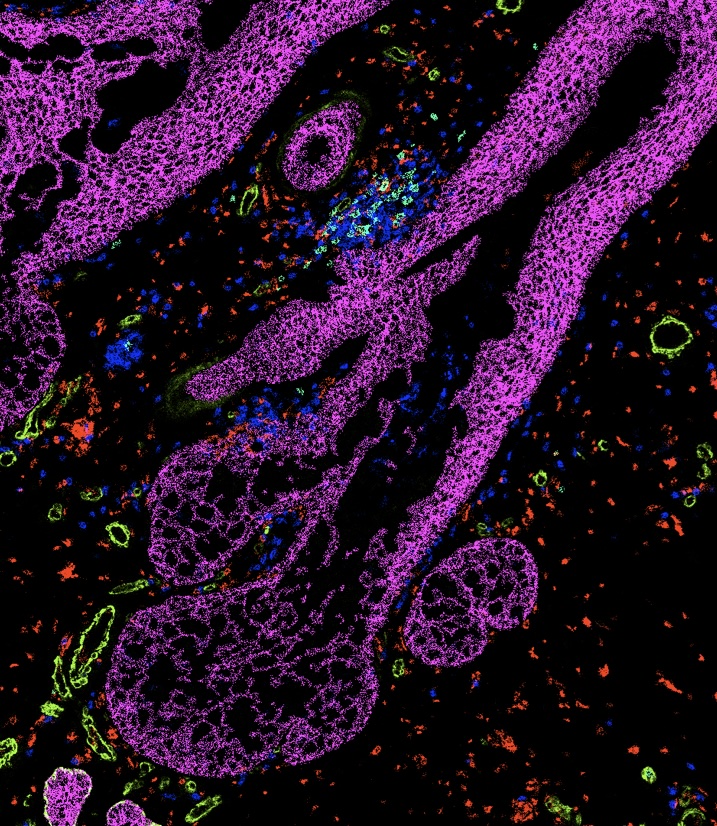
Working with paired biopsies from carefully stratified donor cohorts, you will generate integrated spatial atlases using single-cell spatial transcriptomics (Xenium), highly multiplexed antibody imaging (PhenoCycler) and spatial lipid, metabolite and protein profiling by imaging mass spectrometry (timsTOF fleX). These datasets will be co-registered and analysed using machine learning/AI-driven frameworks established in the host lab. In parallel, you will develop primary keratinocyte air–liquid interface models from younger and older donor scalp, co-cultured with fibroblasts and T cells, and use advanced fluorescence and label-free 3D imaging to quantify epithelial–stromal interactions, differentiation and viability. Models will be challenged with Malassezia-derived metabolites to compare young and aged tissue responses and then used to validate priority targets emerging from the atlases.
You will be based across the Randall Centre for Cell & Molecular Biophysics and the St John's Institute of Dermatology at King's College London, with access to world-class imaging and spatial omics facilities supported by expert technical staff. You will gain interdisciplinary training in cell biology, advanced imaging, spatial omics, computational biology, immunology and clinical dermatology. This is complemented by an industrial placement at Unilever R&D and membership of a UK-wide Unilever doctoral cohort with dedicated training in data science, science communication, IP and commercialisation.
The project will deliver unique multimodal spatial atlases of scalp ageing and dermatitis alongside validated human tissue models for mechanistic studies. Shared in line with FAIR data principles, these resources will advance fundamental understanding of how tissue niches change across the life course. They will also inform new approaches to supporting scalp health in an ageing population and provide a blueprint for spatial multi-omics studies of other tissues and inflammatory skin diseases.
Representative Publications / References
Ungar B, Manson M, Kim M, Gour D, Temboonnark P, Metukuru R, Correa Da Rosa J, Estrada Y, Gay-Mimbrera J, Gómez-Arias PJ, Ruano J, Shemer A, Hanna D, Burnett P, Guttman-Yassky E. Tape-strip profiling identifies unique immune and lipid dysregulation in patients with seborrheic dermatitis. J Am Acad Dermatol. 2025 Jun;92(6):1277-1287.
Adalsteinsson JA, Kaushik S, Muzumdar S, Guttman-Yassky E, Ungar J. An update on the microbiology, immunology and genetics of seborrheic dermatitis. Exp Dermatol. 2020 May;29(5):481-489.
Turchin I, Albrecht L, Hanna S, Kyritsis D, Loo WJ, Lynde CW, Prajapati VH, Purdy K, Rochette L, Wiseman M, Wong D, Yadav G, Yeung J, Gooderham M. Current Understanding of Seborrheic Dermatitis: Epidemiology, Burden of Disease, and Pathophysiology. J Cutan Med Surg. 2025 Nov-Dec;29(4_suppl):5S-15S.
Rau A, Silva GS, Margolis DJ, Chiesa Fuxench ZC. Adult and infantile seborrheic dermatitis:
update on current state of evidence and potential research frontiers. Int J Dermatol. 2024 Nov;63(11):1495-1502.
Restrepo, P. et al. (2026) Single-cell spatial transcriptomic analysis of human skin anatomy. Nature Genetics 58, 903–915. https://doi.org/10.1038/s41588-026-02552-8
Polaskey, M. T. et al. (2024) The global prevalence of seborrheic dermatitis: a systematic review and meta-analysis. JAMA Dermatology 160, 846–855. https://doi.org/10.1001/jamadermatol.2024.1987
Hou, X., Wei, Z., Zouboulis, C. C. & Ju, Q. (2022) Aging in the sebaceous gland. Frontiers in Cell and Developmental Biology 10, 909694. https://doi.org/10.3389/fcell.2022.909694