(UK Home students only)
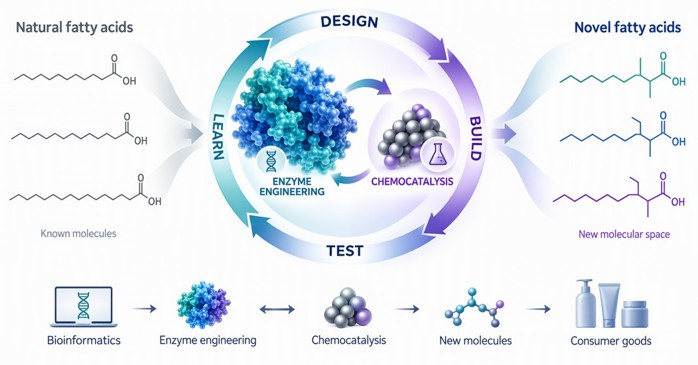
Fatty acids are among the most widely used molecules in consumer products, underpinning the performance of ingredients found in shampoos, conditioners, skin cleansers, moisturisers and many other personal care formulations. Despite their importance, today's portfolio of fatty-acid-based ingredients is largely restricted to molecules that occur in abundance, naturally in plants and microbial oils or can be accessed through conventional chemical synthesis.
A largely unexplored opportunity lies in branched-chain and functionalised fatty acids, molecules rarely found in nature and for which sustainable manufacturing routes do not generally exist. Introducing the seemingly subtle structural changes through modification of natural fatty acids or fatty alcohols to yield such branched/functionalised fatty acids can significantly alter their physical, functional and biological properties. New routes to achieve this could transform the next-generation of formulation or functional ingredients.
This PhD project will investigate whether biotechnology can unlock access to entirely new regions of lipid chemical space. The central hypothesis is that enzyme-guided biocatalytic and chemoenzymatic cascades can transform abundant linear fatty acids or alcohols into novel branched fatty acids that are inaccessible through natural biosynthetic pathways. Working at the interface of engineering biology, biocatalysis and sustainable manufacturing, the student will identify, characterise and engineer enzymes capable of performing selective modifications of fatty acids/alcohols.
The project will combine bioinformatics, ancestral sequence reconstruction, enzyme discovery, protein engineering and directed evolution with laboratory automation and structural biology. Using state-of-the-art facilities at the Manchester Institute of Biotechnology, the student will build and optimise novel biocatalytic pathways and establish sustainable routes in combination with chemocatalysis to yield previously inaccessible lipid structures. The resulting molecules will then be evaluated in collaboration with Unilever to understand how structural changes influence material properties relevant to consumer products.
This project offers a unique opportunity to contribute to the development of next-generation biosourced ingredients, while gaining expertise in some of the most exciting areas of modern biotechnology, including synthetic biology, enzyme engineering, computational protein design and biomanufacturing. The research has the potential to establish entirely new enzyme-enabled manufacturing platforms, provide fundamental insights into enzyme-catalysed lipid functionalisation and unlock novel molecular building blocks for future consumer products.
The successful applicant will join a collaborative research programme between the University of Manchester and Unilever, combining world-leading expertise in enzyme engineering and biocatalysis with industrial insight into ingredient innovation and product development
Representative Publications / References
A few references related to fatty acid modification (1), biocatalysis (2) and enzyme engineering (3) from the supervisory team.
- Matthews et al. JBC, 2017; 292, 5128-5143 https://www.jbc.org/article/S0021-9258(20)34138-7/fulltext
- Payne et al. ACS Catal. 2019, 9, 2854–2865 https://doi.org/10.1021/acscatal.8b04862
- Lister et al. Nature 2025, 639, 375–381 https://www.nature.com/articles/s41586-025-08611-0