(Open to Home and International students)
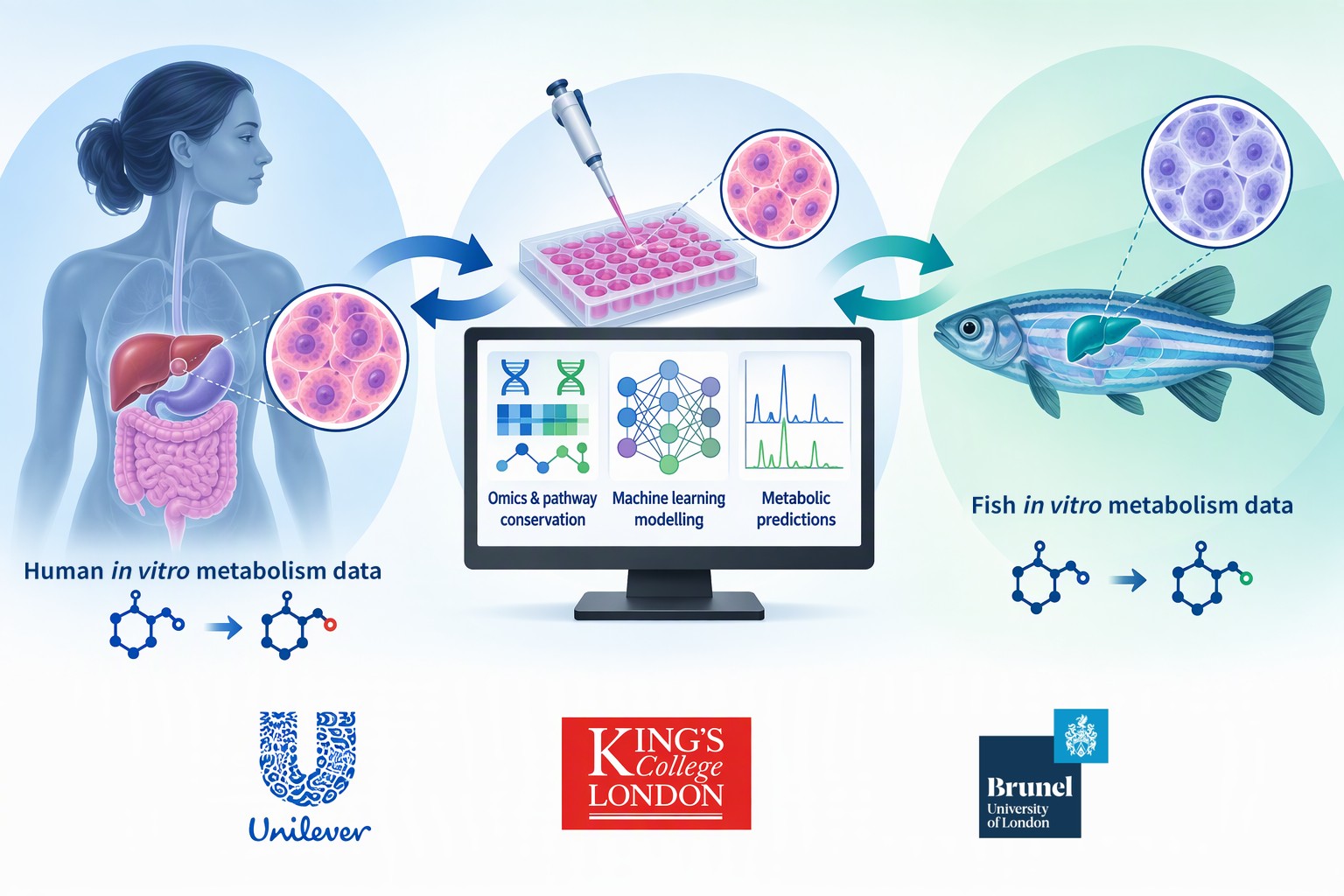
Can what we know about human metabolism help predict how fish metabolise chemicals? When chemicals reach the environment, how fish respond depends on how those chemicals are absorbed, distributed, metabolised and excreted. Metabolism plays a particularly important role, regulating internal exposure, detoxification and metabolite formation. While chemical metabolism is extensively characterised in humans and mammalian systems [1], how far these processes are conserved in environmentally relevant vertebrates such as fish, and how this varies across chemical space, remains poorly understood [2]. This PhD will tackle that gap, supporting chemical risk assessment.
Fish provide a particularly informative comparative vertebrate system because they retain many metabolic pathways relevant to mammalian xenobiotic metabolism despite substantial evolutionary divergence. Fish also sit at the interface between human and environmental health, while established in vitro hepatic systems and omics resources enable molecular conservation to be compared directly with measured metabolic function.
This PhD will test whether conservation of metabolic enzymes and pathways between humans and fish results in predictable similarities in metabolic function, measured through intrinsic clearance and metabolite formation, and whether divergence in these systems explains species- and chemical-specific differences.
New Approach Methodologies (NAMs), including in vitro systems, omics technologies and computational modelling, can address these questions by integrating information across multiple levels of biological organisation, including gene expression, enzyme abundance and metabolite formation [3]. Importantly, intrinsic clearance can be characterised using in vitro approaches without the need for in vivo testing [4].
The project will initially collate existing human and fish clearance, metabolism and omics datasets to characterise the conservation of metabolic enzymes and pathways and identify gaps in current knowledge. Available omics data will be used to generate testable predictions of functional similarity and divergence. Existing resources already provide substantial intrinsic-clearance data, including measurements in human and rainbow trout hepatocytes [4], but matched human–fish data remain limited.
Targeted experiments will therefore generate matched intrinsic-clearance and metabolite-formation data using selected chemicals and human and fish in vitro systems, including hepatocytes and S9 fractions. LC-MS/MS and GC-MS will be used to compare shared and species-specific metabolite formation. Statistical, computational and machine-learning approaches will then integrate clearance, metabolite, enzyme, pathway, transcriptomic and proteomic information to determine whether molecular conservation predicts metabolic function and identify biological and chemical factors responsible for species-specific differences.
Successful delivery would establish where metabolic information can be translated confidently between humans and fish, where species-specific metabolism limits translation, and which molecular or chemical features identify these domains in advance. This will provide a basis for using existing human metabolic data when fish-specific information is limited and support NAM-based toxicokinetic approaches for chemical safety assessment.
The successful student will be based at King's College London, within the Mechanistic Toxicology group led by Dr Luigi Margiotta-Casaluci, with additional interdisciplinary training and supervision through collaborations with Dr Thomas Miller at Brunel University of London and scientists at Unilever. The student will gain a distinctive skill set spanning in vitro methods, mass spectrometry, data science and machine learning, alongside an industrial placement at Unilever.
Representative Publications / References
- Guengerich, F. P. (2024). Roles of individual human cytochrome P450 enzymes in drug metabolism. Pharmacological Reviews, 76(6), 1104–1132.
- Margiotta-Casaluci, L., Owen, S. F., & Winter, M. J. (2024). Cross-species extrapolation of biological data to guide the environmental safety assessment of pharmaceuticals: The state of the art and future priorities. Environmental Toxicology and Chemistry, 43(3), 513–525.
- Smith, K. F., Pochon, X., Melvin, S. D., Wheeler, T. T., & Tremblay, L. A. (2025). Integration of “Omics”-based approaches in environmental risk assessment to establish cause and effect relationships: A review. Toxics, 13(9), 714.
- Black, S. R., Nichols, J. W., Fay, K. A., Matten, S. R., & Lynn, S. G. (2021). Evaluation and comparison of in vitro intrinsic clearance rates measured using cryopreserved hepatocytes from humans, rats, and rainbow trout. Toxicology, 457, 152819.